Monday, August 23, 2010

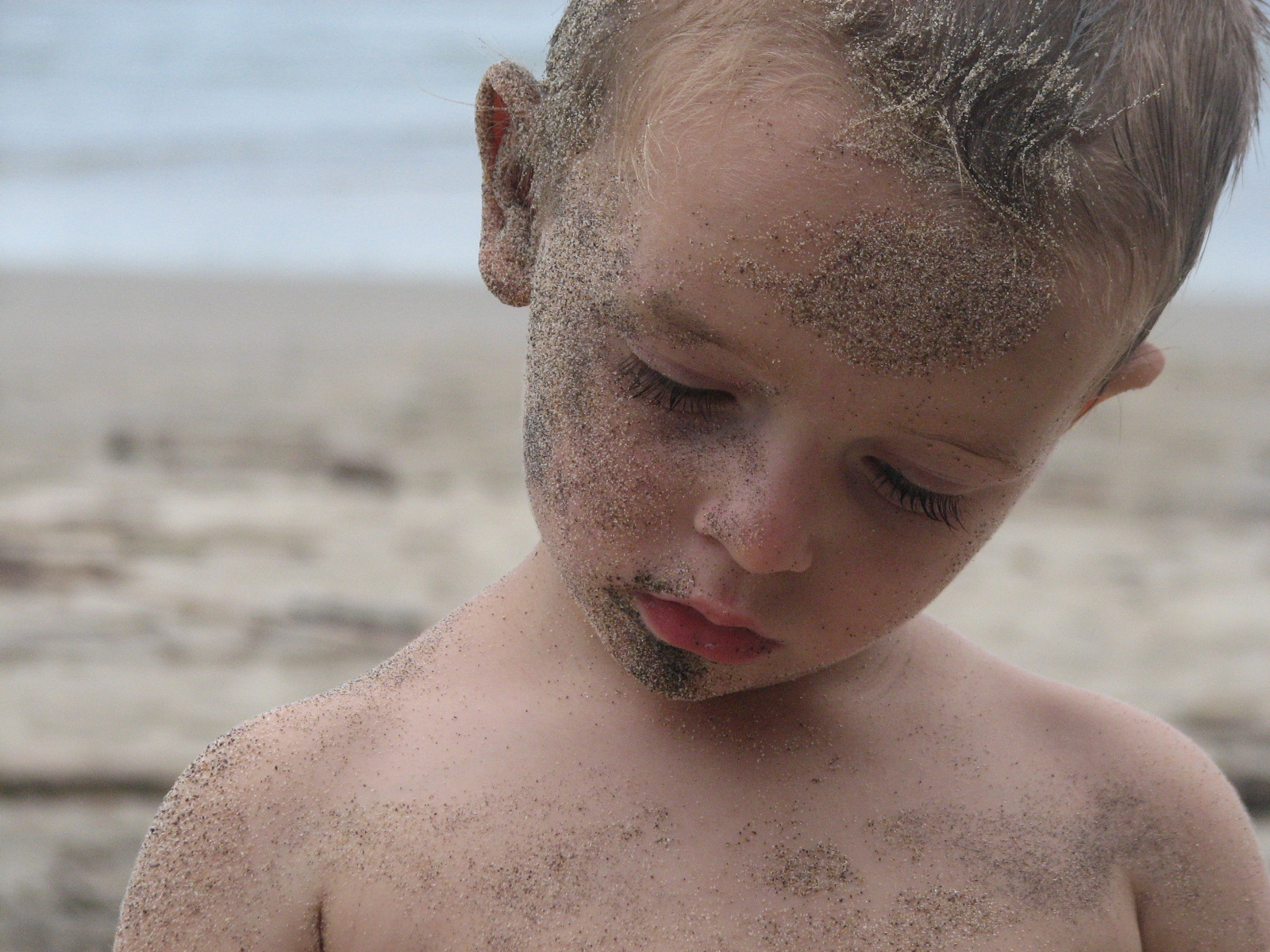
Sand Schnitzel Sighting

After their brush with death and the loss of the famed ornithologist Herr Polmgren in Uluwatu, Bali, the surviving members of the Swedish ornithology club touring Indonesia have reported a rare and surprising find – the elusive sand schnitzel. This rare bird is normally found in and around large, dark green, tortoise-shaped sandpits commonly part of the normal city park terrain. Surprisingly, this fantastic specimen was spotted on a beach in the Kodi region of Western Sumba.


The group was shocked by the find since the point of the trip that day was a leisurely birthday celebration. To commemorate the 39th birthday of one Christian Nixon, the bird watching group traveled to Watu Malondo. Dr. Nixon was said to be having a spectacular time even before the sighting.


The club was shocked to find this bird in such a strange habitat. The sand schnitzel does not normally inhabit sand so close to massive sea stacks and crashing waves. (See the face in the rock?)


Despite this unusual habit, this sand schnitzel seemed quite healthy and vibrant. The club plans to make a second trip in the near future to look for other schnitzels in the area.

Tuesday, August 17, 2010

August 17th


Thanks for all of the positive comments on my last post. Wainyapu is a seriously cool place. There is so much rich tradition and history there. I’ll quickly answer a few questions I received.

1.Yes, we did take Colby to Wainyapu the first day we went. Our nanny was brand new and we were only going for a few hours to meet the Village Chief. We felt it was important to introduce him to the whole family.
2.The people of Wainyapu don’t seem to be starving, but they are malnourished. Their diet is not very well-balanced consisting mostly of rice. We never eat our lunch anywhere near the village. It causes too many problems. We do, however, supply lunch and water for the whole census team each day that we work.
3.There are a wide variety of foods here. They can be difficult (and expensive in local terms) to procure. We are well-fed with a diet of mostly rice, tempe, chicken, eggs, carrots, beans, and bananas.
4.We do take our safety seriously. We are strangers here. Quite odd, in fact. We naturally draw a lot of attention. We do our best to minimize that attention.

Independence Day

August 17th is an important day in Indonesian history – Independence Day. Indonesia is a relatively young country celebrating 45 years of independence. For about a week now, the 3 schools near us have been rehearsing for the big day. The drum band practices start at 7am, even on Saturday. Colby really enjoyed chasing them around the neighborhood.


To celebrate the day, a flag raising ceremony of sorts was held at the town soccer field. All of the local schools lined up in across the field, and the various drum bands and a pom-pom squad paraded across.


A military procession dressed completely in white preceded the flag raising. This procession paraded around the field, the flagpole, and the main hut for almost 45 minutes.


It was an intricate display. They seemed to first ask permission to approach the main hut. Then a portion of the squad approached. Permission was again requested to present the flag for inspection. Once the flag was found to be acceptable, they marched around some more before they finally came to the pole and actually hung the flag. I am not sure I got the point of all of this pomp, but perhaps that is because for half of this time I was chasing grasshoppers with Colby.


As the ceremony was coming to an end (at least for those of us more interested in grasshopper-chasing), Colby became good friends with a police unit that had set up near us. One of them tried to get Colby to hold his automatic rifle. I was torn between not wanting my toddler anywhere near a gun and not wanting to piss off a man holding a gun. In the end, I decided to smile and pose for a photo and keep a tight grip on Colby.


Colby seemed to really like the police. He climbed up in the truck with them.


As we were leaving, we saw one of our helpers –Esty. She is part of a rescue brigade. For the ceremony, she dressed up in uniform and participated in the line –up.


The best part of the day, in my opinion, was the silence that could be found around our neighborhood. It is amazing how much noise a boarding school makes! Since they were all participating in the festivities, 


Bukit Sunyi was fantastically quiet!

Tuesday, August 10, 2010

Wainyapu: Field Site A


This post is relatively long. There is so much to tell you! There are pictures in this post and one of Colby at the very end! 

As you all know Chris and I are here studying malaria. Officially, we are working on a Gates Foundation project. The ultimate goal of this project is to determine the effectiveness of spatial insect repellents. This study will look at 4 separate villages in West Sumba. The first field site, a large village called Wainyapu, was chosen before we arrived. Since this project is in its infancy, the remaining 3 villages are still being determined.


Chris and I are responsible for the parasitology portion of this project, but we can’t just walk into Wainyapu and start asking for blood. First, we have to figure out how many people live there and where their houses are. We are starting from scratch on this one. There are no road signs in the larger towns, let alone tribal villages like Wainyapu. We have hired guides from the village to lead us through the 4 sub-villages within Wainyapu and 2 local guys (Kamilus and Wajiyo) to assist with the census. As you can imagine, making a map is no small task. Our task is complicated language barriers. The official language is Bahasa Indonesia, but each island also has its own language. In Sumba, everyone speaks Bahasa Sumba, which they learned at home, and Bahasa Indonesia, which they learned at school. In addition to these 2 languages, there are numerous tribal languages. In Waiynapu alone, there are 12 distinct tribes with their own tongues. Chris speaks decent Bahasa Indonesia, although rudimentary. My Bahasa Indonesia skills are okay suck. We are practicing constantly and learning new words and phrases everyday, but there is no Rosetta Stone for Bahasa Sumba and there is certainly no dictionary for any of the tribal languages! 

Despite these difficulties, we have accomplished a fair amount in our first week. With only 2 hand-held GPS, paper, and pens, we have hiked throughout Wainyapu, geo-positioned every house, and taken names, ages, and genders for every person living in every house. We have counted 562 houses and approximately 2500 people. 


Now, I get to crunch the data and Chris goes back to the field with Kamilus to geo-position all major landmarks (churches, wells, ponds etc.) and map all of the roads and foot paths. In 2 weeks, we hope to have a map of this interesting village and its fantastic traditional homes.


The houses in the pictures are from the main cluster in Wainyapu, which sits near the coast and is just behind the Pasola Field. Pasola Field is the site of an infamous tribal festival, which includes a realistic reenactment of tribal war. Fortunately, they have switched over to using blunt-tipped spears resulting in almost no deaths and fewer injuries. The stone structures in front of the huts are tombs. The tall spires in the center serve to keep the hut cool and as storage space for things such as rice or the dead bodies of relatives they can’t afford to bury yet. Thankfully, I have not been invited inside any traditional homes!

Waiynapu resides in a region of Sumba known as Kodi. This region has a reputation for being rough. We have not experienced any aggression (except from the local dogs), but the people are rather primitive and poverty is widespread. Most everyone practices subsistence farming and almost all tools are made by hand from materials found in the local area. I have seen men making fishing nets with roughly carved tools, thread, and seashells. Women weave mats out of dried grass and beautiful cloths on looms made out of fallen tree limbs. Livestock sleeps under the traditional huts and graze on grass near each cluster. We have seen water buffalo, pigs, horses, goats, and chickens.


Water is lugged from various wells and rivers throughout the village. Sometimes the closest water source is almost 1 kilometer away. We saw one well that is 17 meters down into a ravine. Young girls throw containers on strings into the ravine and then pull up the water. 


To bathe and wash clothing, they must hike to a river or pond, which is also used for drinking water. Everything is cleaned in this water including livestock.


Unfortunately, I don’t have many pictures of people and their activities. We are not tourists here and have a job to accomplish. It is also considered rude to photograph these people without offering some sort of compensation. The only photo I have are of a small group of children who begged Chris to take their photo. They wanted candy!


While the majority of people in Kodi claim to practice Christianity, the local adat (custom) reigns supreme. They believe the wealth you acquire on Earth can really be taken with you. (Thus, the reason for corpses in the attic – they have to send their relatives off in style.) This wealth includes livestock (one of the primary symbols of wealth), which are sacrificed at the funeral. Fortunately, the practice of also sacrificing wives and servants has become extinct.

Which brings me to an interesting point.... the treatment of women. While I did not observe any physical signs of maltreatment, women are definitely second-class citizens. Families use their daughters to get substantial “belas” (dowries). The man who “purchases” the girl often considers her more like a possession than a person. She must be a good wife, work hard, and produce many children. The first marriage takes place in the church. Subsequent marriages, if the first wife can not produce any more children, if the husband puts his mistress in a “family way”, or if the man has enough wealth for another belas (more than one wife can also be a sign of wealth), all take place with a village ceremony presided over by the Pak Desun (Village Chief). I met several men with 2 and 3 wives. Supposedly, there is one chief in the region who has 12 wives. These marriages are not legal in the eyes of the Indonesian government, but are valid to the tribe and the village. I asked about the case of Love. What if two people fall in love, but the man doesn’t have enough for the belas (which can be adjusted depending on how much the family likes the match)? Often, the girl will be come pregnant on purpose accident, which requires they get married. The pair spend the majority of their lives trying to pay the belas owed to the family.

I have met many women during the census. Again, none seemed outwardly unhappy. All looked very tired and many times older than their years. I was shocked at the number of children these women already had. By the time they reach my age (the ripe old age of 30), they have at least 4 children, but often 6 or 7. They were equally shocked that I only have one child. I could see they felt sorry for me, because this meant I am either physically weak or my children have died. I am fascinated by their perception of me. When Pak Gerson (my local guide) informs them I am an “ibu doctor amerikat” (American female doctor), a few look at me with awe, many look at me with a hint of disapproval. This disapproval fades from their faces some when he goes on to explain that my husband is also a doctor and he is just over in the next hamlet. I wish I knew enough of the local language to find out what they are really thinking.

While I feel safe in Waiynapu walking with Pak Gerson, (pictured here with Kamilus)


I would not wander through the village without a local guide. Chris attempted to map some roads on his own one afternoon through a portion of the village he was familiar with. He was not met with aggression, but was harassed for money. Adults merely asked repeatedly, while children physically reached into his pockets. Two men who asked for money were pacified somewhat when he told them we would consider making a donation to the local schools before returning to America in a year. Unfortunately, they switched tactics and offered Chris some alone time with their teenage daughters for “seratus” (100,000 rupiah or about $12). He has not tried to work alone since. His words – “It was just too crazy.”  

As promised, here is a picture of Colby and his new best friend, Darcy, sharing a plate of nasi!


Thursday, July 29, 2010

Kamar Kecil dan Air


C3 has arrived in Waitabula, Sumba! (Or Weetabula – it is spelled differently every time I see it written.) We are settling into our house, which is much more spacious than I had imagined.


As you can see, Chris is bubbling with joy. This job has been a lifelong dream for him and it is actually coming true!

There is so much to write about (e.g. our new helpers: Este and Novi, Colby’s new friends, and the field site Wainyapu and its chief Pak Cornelius). I think these items deserve separate posts. For this post, I will tell you about the delicate situation that is the bathroom (kamar kecil). In my last post, I was hoping for an actual toilet seat.  In the real world, boys and girls, wishes don’t always come true. What we got instead of a Western style bathroom is a traditional mandis. It is nicer than having no bathroom at all, but it will take some getting use to. This is the toilet.


I don’t think you are supposed to sit down. Instead, you hover. It’s like camping. When you are finished, you use the pan in the photo to pour water into the toilet for “flushing”.

To take a shower, there is another section in the bathroom with a larger holding tank and another pan. The water sits in this stone basin in the shade and becomes very cold. VERY cold. Um...It’s quite... shocking refreshing first thing in the morning.


When we arrived, it was exciting to see that the house had running water (Air). There is a faucet in the toilet area, the shower area, and in the kitchen. We share a ground well with the boarding school next door. (Trust me. A whole other post!) Our water is relatively clean and can be used for cooking, washing vegetables and dishes, and other cleaning. Our helpers boil water for drinking.

The water is was pumped from a ground well into a holding tank. Then, another pump brought the water into the house.

On our first morning here, we ran out of water. I couldn’t believe that our small family could impact a tank meant for a boarding school that much!  I decided that it must be washing day at the school. When we came back from the field site, Novi told us that we had water in the kitchen, but only a trickle was coming out in the bathroom. Pak (Mister) Kosmus, our landlord, came over and discovered that ALL of our water was in one of the neighbors yard. Their yard was totally flooded! Apparently, a pipe somewhere under the tile floor of the house between the kitchen and the bathroom had burst. Pak Kosmus disconnected the house from the pump and installed a hose.

For now, we (by we, I mean our amazing helpers) have to carry water into the house in buckets. Pak Kosmus told us that we have three options to fix the situation.


  1. We could leave it like it is.


  2. We could get a longer hose and run it into the house to fill up the necessary basins.


  3. We could buy a holding tank and Pak Kosmus would have it installed and new pipe run to the faucets in the house. The smallest tank is 800 liters and costs about 1,000,000 rupiah (~$110). He claims this would take 2 days.
I think the girls are hoping that Pak Chris (that would be Chris) and Ibu Tina (that would be me) decide on option 3. Pak Chris and Ibu Tina think this option is probably best for everyone, but have to wait until the ATM is working again more money.

Once the leak was stopped, the holding tank for the school and the house filled up. Unfortunately, it didn’t shut off and the tank in our yard overflowed. The flow didn’t fill up our yard, which was my initial concern.  I mean who doesn't need  a nice big mosquito breeding ground in their front yard when you live in a malaria endemic region. Instead, the resulting river flowed down our dirt street and ran into a different neighbor's yard. We are really popular. At least, the local kids liked it.


Tuesday, July 20, 2010

SUMBA-Bound


A quick update:

The Indonesian government has granted our official Kitas (VISAS), and they are finally under the right names!  The minister of science had the main visa under my name with Chris being my female spouse.  This clerical error raised some red flags at immigration when they realized I am a girl and Chris is a boy.  This whole process was again supposed to only take three days, but we have been in Jakarta for two weeks!  Regardless, we have the proper paperwork to legally work and live in Indonesia for one year.  We also are allowed to leave Indonesia during the year and return to Sumba hassle free!  Christmas in Australia, anyone? 

Jakarta might be a dirty, busy city, but we have enjoyed our time here - mostly taking in all of the strange contradictions that abound.  I mentioned already the dichotomy between off-road and on-road personalities.  There was also a woman outside of a mosque dressed modestly and wearing a hijab, but the man next to her was wearing a black T-shirt with the words “The Virgin”.  I can only assume that he does not speak English.  I wanted to say to him, “Excuse me sir, but you know your shirt could be referring to the Virgin Mary.  You know, the mother of Jesus – the other team.”  We found another glaring contradiction near the harbor in the old neighborhood called Batavia.  There is a canal of sorts down the middle of a main street.  On either side is a large sidewalk and the canal has lights all along it pointing over the water – illuminating the sludge flowing in the canal gently taking trash and feces to the ocean.  Surrounding this olfactory offense was beautiful, old hotels, historic buildings from the 1600s, and a famous 1930s-style Jazz bar and restaurant called the Batavia CafĂ©. 

Well... Goodbye Jakarta and Hello Sumba!  (I am a little nervous about what our toilet will be like.  Keep your fingers crossed for something more than a hole in the ground!)   

Thursday, July 15, 2010

Choo-Choo!

There are subway and train systems all over the world and in almost every major city.  They are great ways to transport large numbers of people.  Each train system is unique with characteristics that set it apart from other systems and firmly identify it with a particular region.  For example, the subway in Singapore was superbly clean and thoroughly organized.  Trains there ran with extreme precision and the passengers were consistently polite offering their seats to those in need. 

The train system in Jakarta is completely different, but fits the city perfectly.  The trains are dusty and dirty and get to their destinations...well... whenever they get there. 


Instead of paying for your ticket by distance like in Singapore, you pay by the class of the train.  It costs about $1 to ride the Express AC.  This train goes to major destinations only and gets there with frightening speed.  The doors on this train close and it isn’t very crowded.  The Ekonomi AC costs about $0.50 and stops at every station along its track.  It can be rather crowded (watch your belongings!), but the doors close.  This train is a good option if say you miss the last Express AC back to Jakarta while on your trip to Bogor Botantical Gardens, you know...for example.  The Ekonomi train costs $0.12 per trip and is always crowded.  The doors do not close on this train.  Why?  I came up with 3 reasons:
1.  The doors are broken.
2.  Having the doors open lets in more air and saves passengers from heat stroke and/or the stench.
3.  More people fit on a train with open doors. 

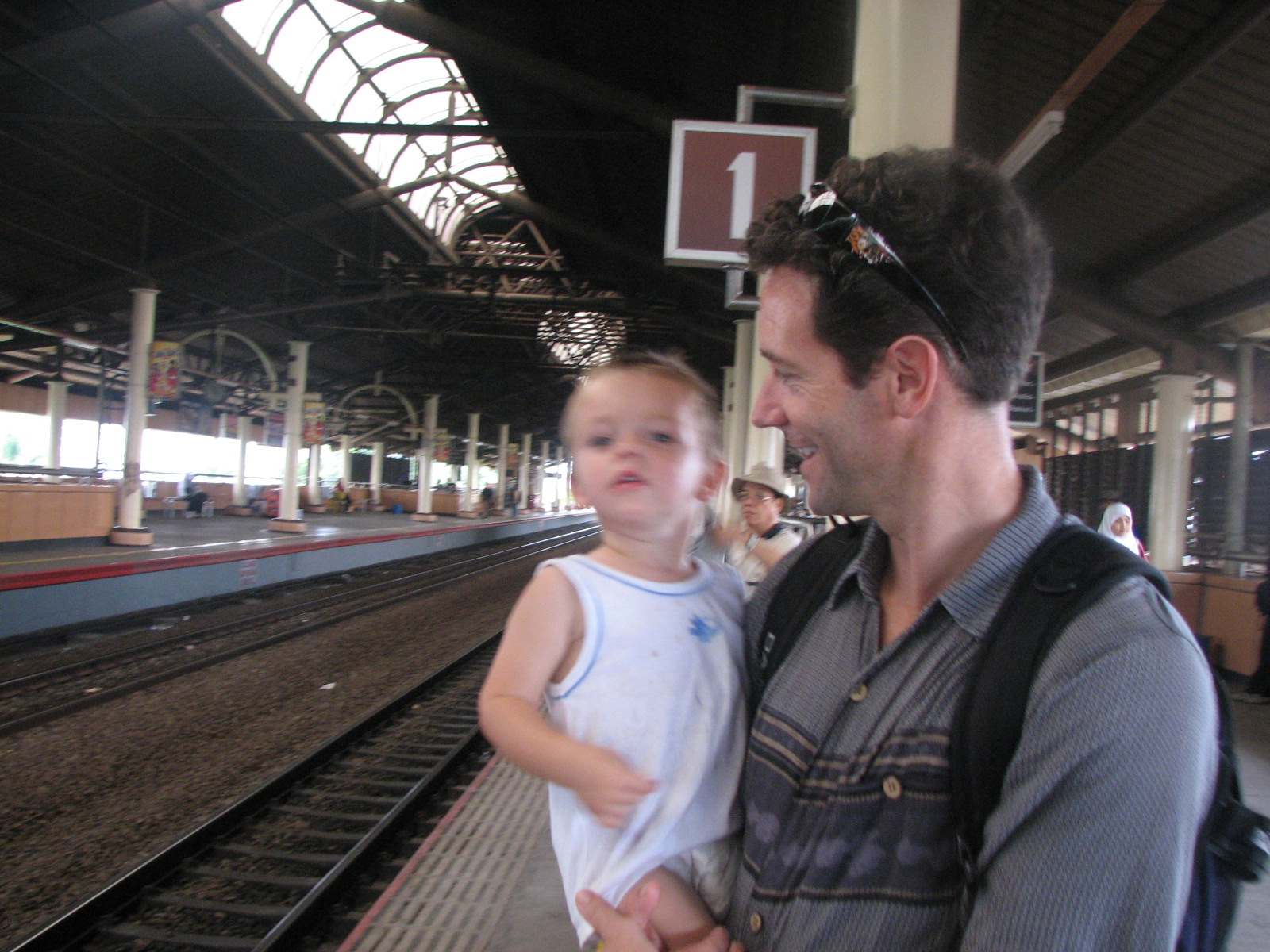
We took an Ekonomi train from the Eijkman Institute one afternoon, mostly out of curiosity.  Luckily, the train was not very crowded that day.  The whole experience made me extremely nervous, though. 


Colby was thrilled to wait in the train station and watch all of the trains go by.  He was so excited that he babbled incoherently.  Now, I know he babbles incoherently most of the time, but this was babbling so fast that he could hardly breathe.


It wasn’t until we saw this Jakarta phenomenon that all of C3 were speechless.  Fortunately, I was able to pull it together long enough to snap a photo!


Tuesday, July 13, 2010

Jakarta Kotor


Warning: This post is lacking in photos.  If you are only interested in pics of Colby, please ignore the text and scroll to the bottom!

C3 is still in Jakarta, and the work has started! I am actually enjoying being back in a lab environment and thinking about a scientific problem.  I am starting to put together some ideas to write grants to help bring in some funding.  It is interesting and exciting to think about a different problem and get to come up with my own ideas.  Although, I will admit it is extremely overwhelming!!

We have met the team at the Eijkman Institute.  We are working for Kevin Baird and the Eijkman-Oxford Clinical Research Unit.  While here, we are learning techniques we will be using in the field like how to make thick and thin blood films for malaria identification.  We are supposed to leave at the end of this week for Sumba.  The rest of the team will be joining us shortly and staying for 2 weeks to do a massive field study.  We are testing a new, rapid diagnostic test for an inherited blood disorder (G6PD deficiency) that has effects on malaria infection and treatment.  The company who makes the test is giving us 1,000 for the study.  The team will go to remote locations in Sumba, set up makeshift labs, and enroll 1,000 (hopefully) registrants in two weeks to test the efficacy of this new test.  Talk about being thrown into the fire! 

Chris is also still dealing with our immigration/visa status.  (He has to speak for all of us, because Indonesia is still primarily a patriarchal society.  I am trying to not let this... um... “cultural difference” bother me.  I am successful about 40% of the time.  I am pleased with this rate.  It is an improvement.)  We have our visas (from the Embassy), and our research permit (from the Minister of Science - RISTEK).  Now, we have to get “stay” permits from immigration and the police.  At every juncture, each agency has collected its own set of fees.  This process has been more complicated, and more expensive, than any of us imagined, but we are at the finish line!

Most of our time here has been in the city-proper.  Jakarta is a big, dirty city full (and I do mean full) of people.  It is not a pretty city, but there is something strangely interesting about it.  For instance, everyone here seems to have a dual personality.  The first personality is the one you meet in an office or shop setting.  They are calm, rational, easy-going, and overly optimistic.  They second personality rears its proverbial head on the streets of Jakarta where it has probably developed out of necessity.  They are wreck-less and almost rage-full.  Defensive driving (or walking, for that matter) is not an option.  Without sheer aggression when facing your daily commute, you will not survive on the streets of Jakarta.  I can think of several cities in the U.S. where driving is also aggressive, but 2 differences stand out.  First, the dichotomy between the non-road personality and the road personality is not as striking.  Cities with aggressive drives are also filled with equally aggressive business people and politicians.  Second, cities in the U.S. have traffic signals and actually use them.  True genius.  


There really isn’t much to see or do here, especially for kids.  The nightlife, we are told, is exceptional, but it starts a little too late (i.e. after 9pm) for tiny Master Nixon.  Though, I am sure he would love a good dance party.  This past weekend, we needed a break from Jakarta so we took the train (an adventure which deserves a posting all of its own- with pictures, promise!) to Bogor.  Bogor is a suburb of Jakarta that boasts a large botanical garden.  This garden was beautiful, but in a very different way than the garden in Singapore.  It gave us just what we wanted: a large green area for Colby to run and be crazy.  As always, he made tons of friends and somehow managed to find bubbles.